
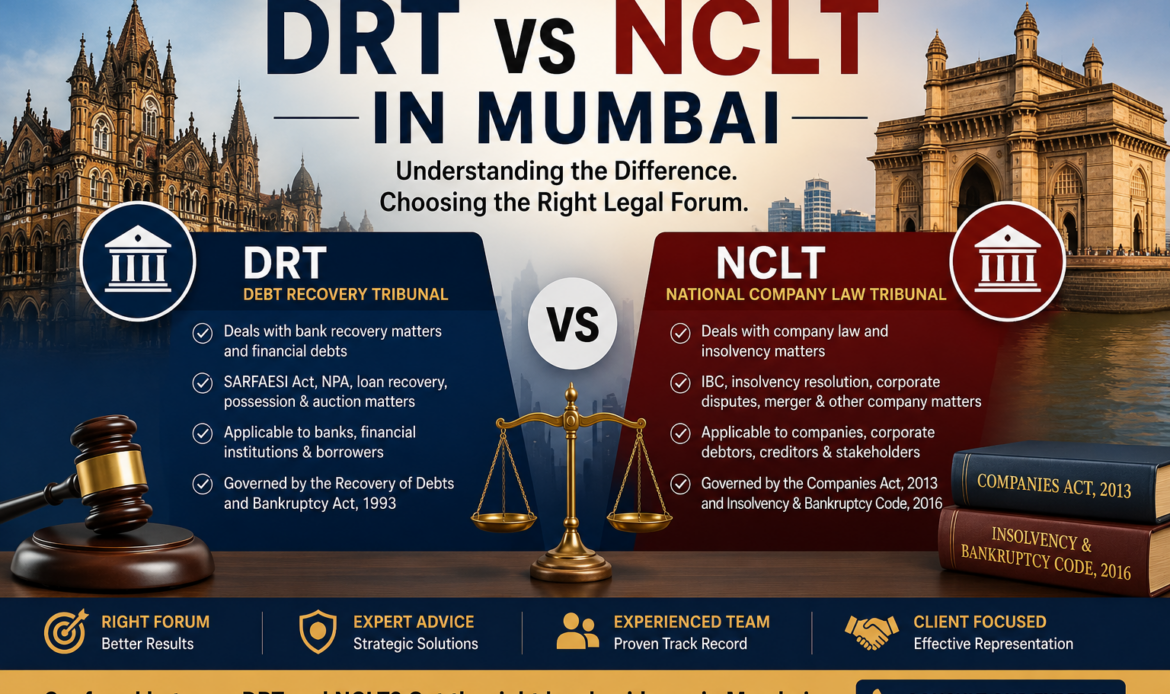
Many borrowers, businesses, creditors and company directors get confused between DRT and NCLT. Both forums deal with financial disputes, but their purpose, jurisdiction and remedies are different.
DRT generally deals with debt recovery matters involving banks and financial institutions, while NCLT deals with company law, insolvency and corporate restructuring matters. Understanding the difference is important before choosing the right legal remedy.
What is DRT?
DRT stands for Debt Recovery Tribunal. It was created to help banks and financial institutions recover debts through a specialised tribunal process. DRT matters commonly involve SARFAESI action, recovery applications, NPA disputes, possession notices, auction challenges and DRAT appeals.
The official government explanation says DRTs and DRATs were established under the Recovery of Debts and Bankruptcy Act, 1993 for expeditious adjudication and recovery of debts due to banks and financial institutions.
What is NCLT?
NCLT stands for National Company Law Tribunal. It deals with company law matters, corporate insolvency, shareholder disputes, oppression and mismanagement, mergers, liquidation and IBC proceedings. The NCLT was constituted under Section 408 of the Companies Act, 2013 and Mumbai has an official NCLT bench.
Main Difference Between DRT and NCLT
| Point | DRT | NCLT |
|---|---|---|
| Main purpose | Debt recovery for banks/financial institutions | Company law and insolvency matters |
| Common law involved | RDB Act, SARFAESI Act | Companies Act, IBC |
| Common parties | Banks, NBFCs, borrowers, guarantors | Companies, creditors, directors, shareholders |
| Common cases | SARFAESI, NPA, possession, auction, recovery | CIRP, liquidation, shareholder disputes, company petitions |
| Appeal forum | DRAT | NCLAT |
| Best for | Bank recovery disputes | Insolvency and company disputes |
When Does a Case Go to DRT?
A case may go to DRT when the issue is mainly related to bank recovery or enforcement of secured assets. For example:
- A borrower receives SARFAESI notice
- A bank classifies an account as NPA
- A secured property is taken into symbolic or physical possession
- Auction notice is issued
- Bank files a recovery application
- A guarantor is facing recovery action
- A party wants to challenge DRT order before DRAT
When Does a Case Go to NCLT?
A case may go to NCLT when the matter involves a company, corporate debtor, insolvency, shareholder issue or company law dispute. For example:
- A financial creditor files IBC proceedings
- An operational creditor files for unpaid dues
- A company faces CIRP
- Shareholders allege oppression or mismanagement
- A company requires restoration
- Liquidation or restructuring is involved
- Directors or promoters need legal defence in insolvency proceedings
Can DRT and NCLT Overlap?
Yes, in some cases, both DRT and NCLT issues may arise around the same debt or corporate borrower. For example, a bank may take SARFAESI action while insolvency proceedings are also discussed or initiated. This overlap requires careful legal strategy because wrong timing or wrong forum selection can harm the client’s position.
This is why businesses, borrowers and creditors should consult a legal team that understands both DRT and NCLT proceedings.
Why BM Legal for DRT and NCLT Matters in Mumbai?
BM Legal’s practice areas include DRT, SARFAESI, DRAT, NCLT and insolvency matters. This allows the firm to assess whether a client’s case belongs before DRT, NCLT, DRAT, NCLAT or another forum.
A strong legal approach involves:
- Identifying the correct forum
- Checking limitation and maintainability
- Reviewing notices and documents
- Preparing urgent applications where required
- Advising on settlement or litigation strategy
- Representing clients before the appropriate tribunal
Conclusion
DRT and NCLT are both important forums, but they are not the same. DRT is mainly connected with bank recovery, SARFAESI and debt recovery proceedings. NCLT is mainly connected with insolvency, company law and corporate disputes.
For clients in Mumbai, the right legal step depends on the facts, documents, parties involved and urgency of the matter. BM Legal provides legal support for both DRT and NCLT matters, helping clients understand the correct forum and available legal remedies.
If your matter involves SARFAESI notices, NPA disputes, possession notices or bank recovery proceedings, you can read our detailed guide on choosing a DRT law firm in Mumbai.
For company disputes, insolvency petitions, IBC proceedings and shareholder matters, you can also read our detailed guide on working with an NCLT law firm in Mumbai.
FAQs
1. Is DRT the same as NCLT?
No. DRT deals mainly with bank recovery and SARFAESI matters, while NCLT deals with company law and insolvency matters.
2. Which forum handles SARFAESI matters?
SARFAESI-related challenges are generally handled before DRT.
3. Which forum handles IBC matters?
Corporate insolvency matters under IBC are handled before NCLT.
4. Can a bank recovery matter also involve NCLT?
Yes, if insolvency proceedings are initiated against a corporate debtor, DRT and NCLT-related issues may overlap.
5. Should I consult a DRT lawyer or NCLT lawyer?
It depends on the notice, dispute type and legal forum involved. A law firm handling both DRT and NCLT can guide you better.
BM Legal provides legal assistance in DRT matters, including recovery proceedings, SARFAESI disputes, bank recovery cases and DRAT-related issues.
For official information on Debt Recovery Tribunals and DRATs, readers may refer to the Department of Financial Services explanation of Debts Recovery Tribunals and Debts Recovery Appellate Tribunals.
For company law and insolvency-related tribunal information, readers may refer to the official National Company Law Tribunal website.